admin
Maaz Digital Marketing | Business guide | 16 November 2026
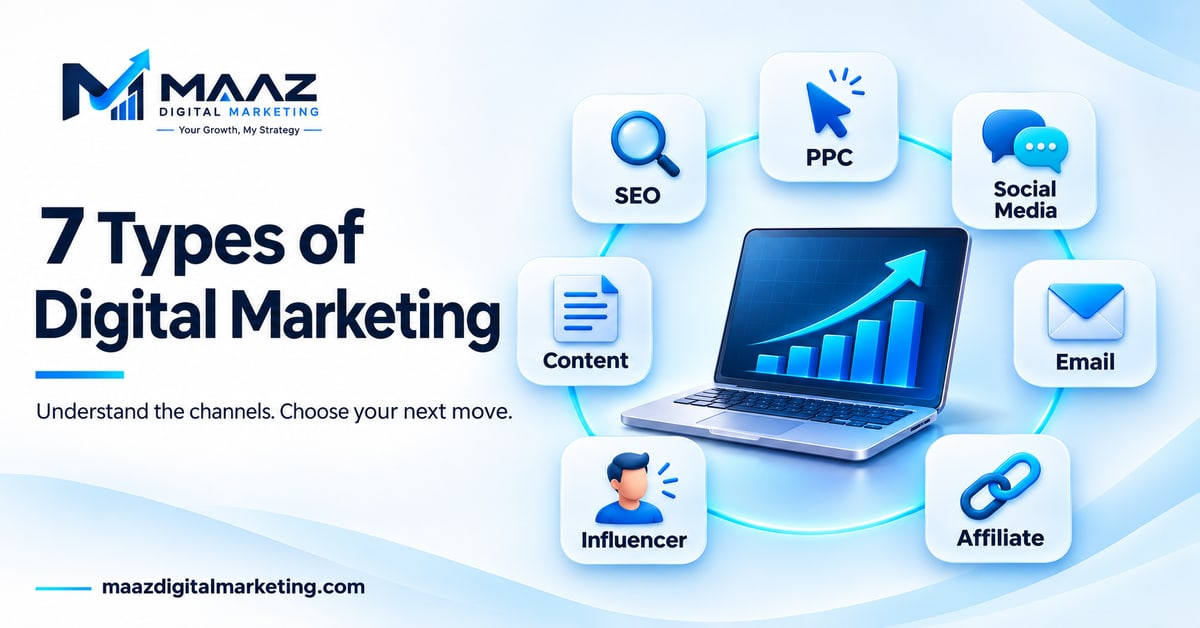
The seven types of digital marketing covered in this guide are search engine optimization (SEO), pay-per-click (PPC) advertising, social media marketing, content marketing, email marketing, influencer marketing, and affiliate marketing. Each helps a business reach or retain customers in a different way. The right starting mix depends on your audience, offer, resources, and goals.
- SEO: Help customers find you through unpaid search results.
- PPC advertising: Pay for clicks on relevant advertisements.
- Social media marketing: Reach and engage people on social platforms.
- Content marketing: Answer customer questions with useful information.
- Email marketing: Nurture subscribers and encourage repeat business.
- Influencer marketing: Collaborate with creators who reach your audience.
- Affiliate marketing: Reward partners for agreed results, such as referred sales.
These categories overlap, and there is no universal rule that digital marketing has exactly 7 types. Use them to understand your options before deciding where to invest.
What does each type of digital marketing do?
Digital marketing uses online channels and digital communication to attract, convert, and retain customers. SEO and advertising can capture existing demand; content, social media, and creators can introduce or explain an offer; email can support follow-up; and affiliates can generate referrals. Their roles change with the audience and buying journey.
|
Type |
Main purpose |
Practical example |
Useful business metric |
|---|---|---|---|
|
SEO |
Capture relevant searches |
A clinic's local service page |
Qualified organic enquiries |
|
PPC |
Buy relevant website visits |
A Google Search advertisement |
Cost per qualified lead |
|
Social media |
Build discovery and engagement |
A clothing store's product demo |
Enquiries and attributed sales |
|
Content |
Help buyers understand and decide |
A supplier's buying guide |
Content-assisted enquiries |
|
|
Nurture and retain customers |
A subscriber product update |
Revenue per delivered email |
|
Influencer |
Reach a creator's audience |
A restaurant's creator collaboration |
Attributable bookings or orders |
|
Affiliate |
Generate partner referrals |
A tracked product recommendation |
Margin after commissions |
1. What is search engine optimization (SEO)?
Search engine optimization (SEO) is the process of improving a website's content, structure, and technical accessibility so people can discover it through unpaid search results. For local businesses, related work also includes maintaining an accurate Google Business Profile. SEO aims to attract relevant visitors who can become customers.
Google's SEO Starter Guide explains that SEO helps search engines understand content and helps users discover and evaluate a website.
Illustrative example: A dentist in Hyderabad publishes a clear treatment page, adds useful appointment information, and keeps the clinic's business profile accurate. The aim is to help relevant patients find and assess the practice.
- Start with a useful page for your main service and a check that search engines can access it.
- Measure: Qualified inquiries and appointments, alongside relevant search clicks.
- Watch for: Traffic that never becomes an inquiry. Organic clicks carry no ad charge, but content, maintenance, and specialist work still cost resources.
2. What is pay-per-click (PPC) advertising?
Pay-per-click (PPC) advertising is an advertising model in which an advertiser pays when someone clicks an ad. Search campaigns are a familiar example: an ad can appear when a person searches for a relevant product or service. Results depend on targeting, the offer, the landing page, and follow-up.
Google defines cost-per-click bidding as paying for each click. Not all digital ads use this payment model; some charge for impressions or other outcomes.
Illustrative example: An academy advertises a specific course and sends visitors to a page with fees, eligibility, class timings, and an enquiry form.
- Start with one clear offer, a focused landing page, and working conversion tracking.
- Measure: Cost per qualified inquiry and the percentage of inquiries that become enrollments.
- Watch for: Paying for clicks from people outside your service area or looking for something you do not offer.
3. What is social media marketing?
Social media marketing uses platforms such as Instagram, Facebook, LinkedIn, and TikTok to reach people, share useful content, and manage customer conversations. It includes organic activity and paid promotion. A business should choose platforms based on its customers' behavior and its ability to publish relevant material consistently.
Example: A clothing store shares a short fit demonstration, answers sizing questions, and links to the exact product shown. A paid campaign can extend distribution, but a popular post alone does not establish profitability.
- Start with one relevant platform and content addressing common buying questions.
- Measure: Product visits, qualified messages, orders, and supporting engagement.
- Watch for: Treating follower growth as proof of sales. Separate organic and paid results so you can understand what each activity contributes.
4. What is content marketing?
Content marketing is the creation and distribution of useful information that helps a defined audience solve problems and make decisions. Articles, videos, case studies, comparison guides, and product demonstrations are common formats. Content can support search visibility, social discovery, email follow-up, and sales conversations within the same marketing strategy.
Example: A textile wholesaler publishes a guide to fabric weights, minimum order quantities, and sample requests. Buyers can use it before contacting the sales team.
- Start with a question customers repeatedly ask before purchasing.
- Measure: Relevant visits, assisted enquiries, and how sales staff use the resource.
- Watch for: Publishing generic advice that never explains your actual product, process, or offer.
Content and SEO are connected, but they are not interchangeable. A buying guide is content; making it discoverable through relevant search queries is part of SEO.
5. What is email marketing?
Email marketing uses messages sent to subscribers or customers to share relevant information, nurture interest, and encourage repeat business. Common examples include welcome sequences, newsletters, and product updates. Effective email marketing depends on permission, useful segmentation, reliable delivery, and a clear reason for the recipient to take action.
Example: A clothing retailer lets shoppers subscribe to new collection updates, then sends relevant product information and a direct shopping link.
- Start with a clear signup offer and a useful welcome email.
- Measure: Clicks, purchases, revenue per delivered email, and unsubscribes.
- Watch for: Purchased lists, irrelevant messages, and treating open rates as a complete measure of engagement.
An email list gives you a direct way to reach subscribers. It still needs maintenance, respectful communication, and a working unsubscribe process.
6. What is influencer marketing?
Influencer marketing involves working with creators whose audiences are relevant to a business. A creator may demonstrate a product, explain an experience, or introduce an offer through sponsored content. The value of a partnership depends on audience fit, credibility, content quality, and measurable outcomes, rather than follower count alone.
Example: A restaurant works with a Hyderabad food creator whose audience includes nearby diners. The collaboration features the menu, location, and booking method, with the sponsorship clearly disclosed.
- Start with: Audience relevance, agreed deliverables, and permission to reuse content where needed.
- Measure: Trackable bookings, orders, or qualified inquiries, alongside reach.
- Watch for: Paying for a large audience that rarely buys in your market. A creator's popularity does not guarantee commercial results.
7. What is affiliate marketing?
Affiliate marketing is a partnership model in which a business rewards a partner for an agreed result, commonly a sale generated through a tracked referral. Partners may use links or codes to identify referrals. Businesses need clear commission terms, reliable tracking, and rules for returns, cancellations, and qualifying transactions.
Example: A publisher recommends a store's products through a tracked link and earns commission on eligible completed purchases.
- Start with a product that converts, has a sufficient margin, and has straightforward partner terms.
- Measure: Validated sales and contribution margin after commissions and other variable costs.
- Watch for: Counting cancelled orders as success or confusing discounted existing-customer purchases with genuinely additional sales.
An influencer can also be an affiliate. “Influencer” describes the audience relationship; “affiliate” describes how the partner earns a reward.
Why do some guides list different types of digital marketing?
Different guides classify digital marketing by channel, content format, payment model, or supporting discipline. That produces different totals without making every alternative list incorrect. This guide uses seven useful categories for business planning while recognizing that video, mobile messaging, analytics, and other activities can span or extend those categories.
For example, Southern New Hampshire University's guide uses eight categories and includes mobile marketing and marketing analytics. Analytics also supports decision-making across all seven types discussed here.
The “7 Ps” is a separate marketing-mix framework, not another name for these digital channels.
Where do video, mobile, and WhatsApp marketing fit?
Video is a content format that can appear in social posts, advertisements, emails, and website pages. Mobile marketing describes activity designed for mobile devices and can include messaging or app experiences. WhatsApp is a messaging channel that can support inquiries and customer follow-up; it is not a form of email.
A product demonstration can therefore be both video content and social media marketing. Classify it in the way that helps your planning, then avoid counting the same sale twice across reports.
Where do AEO and AI search fit?
Answer engine optimization (AEO) describes efforts to make information clear, accessible, and useful when systems answer users' questions. It overlaps with SEO and content marketing through precise definitions, helpful explanations, and credible sourcing.
Google states that established SEO practices remain relevant to AI Overviews and AI Mode, with no special additional optimization required. Clear headings, accessible text, and accurate information help readers; a particular answer length does not guarantee selection by an answer engine.
How do you choose the right digital marketing channels for your business?
Choose digital marketing channels by matching a measurable business goal to how your customers discover, evaluate, and buy your offer. Consider your budget, available skills, sales cycle, and existing assets. Start with a manageable combination, establish a baseline, and expand when evidence shows that the activity produces worthwhile outcomes.
- Define the outcome. Choose appointments, qualified enquiries, orders, or repeat purchases.
- Map customer behavior. Ask how existing customers found you and what they needed before buying.
- Check readiness. Review your offer, landing page, response process, and tracking.
- Choose an initial mix. Prioritise channels you can resource properly.
- Set a review point. Compare qualified outcomes and costs over a period appropriate to the channel and sales cycle.
|
Business situation |
Possible starting mix |
Why it fits |
Main constraint |
|---|---|---|---|
|
Local service with search demand |
Local SEO + useful service pages; targeted ads if suitable |
Helps people find and assess a nearby provider |
Local competition and appointment capacity |
|
Online store with visual products |
Social content + product pages + email; paid testing if ready |
Connects product discovery, purchases, and repeat business |
Product margin and conversion rate |
|
B2B supplier with a longer sales cycle |
Search-focused content + targeted outreach or promotion + email nurturing |
Supports research and follow-up |
Lead quality and sales response |
Which channels fit local service businesses?
Local service businesses can start by improving visibility for relevant nearby searches and making it easy to inquire or book. Useful service pages and an accurate Google Business Profile support that work. Targeted search advertising may complement the approach when demand, budget, conversion tracking, and the ability to handle inquiries align.
For a clinic, that means clear treatment information and a reliable appointment process. Google explains that local ranking depends mainly on relevance, distance, and popularity; buying ads does not buy better organic local rankings.
Which channels fit an online store?
An online store should choose channels around product discovery, purchase confidence, and repeat buying. Social content and creators can demonstrate products, search can capture existing demand, and email can support retention. Paid promotion becomes more useful when product pages, checkout, fulfillment, and margins are ready to support additional orders.
For a clothing store, show fit, fabric, delivery charges, and return information before increasing promotion. Better traffic can’t compensate indefinitely for missing product details or a difficult checkout.
Which channels fit a B2B business?
A business-to-business company should focus on reaching the right decision-makers and helping them evaluate an offer. Search-focused content, relevant professional platforms, and email nurturing can support that process. Because purchases may involve several people and a longer sales cycle, qualified opportunities and eventual revenue matter more than raw lead counts.
A wholesaler's product specifications, ordering requirements, and sample process can do more for buyer confidence than frequent generic social posts.
Unsure where to start? Explore Maaz Digital Marketing's SEO and advertising services and request a free audit. Share your website, service area, and main goal so the conversation starts with your business priorities.
How can the 7 types work together?
The 7 types of digital marketing can support different moments in the same customer journey. A person might discover a brand through social content, compare options through search, and return after an email. Connecting messages, offers, and measurement helps the channels reinforce one another without requiring every business to use all seven.
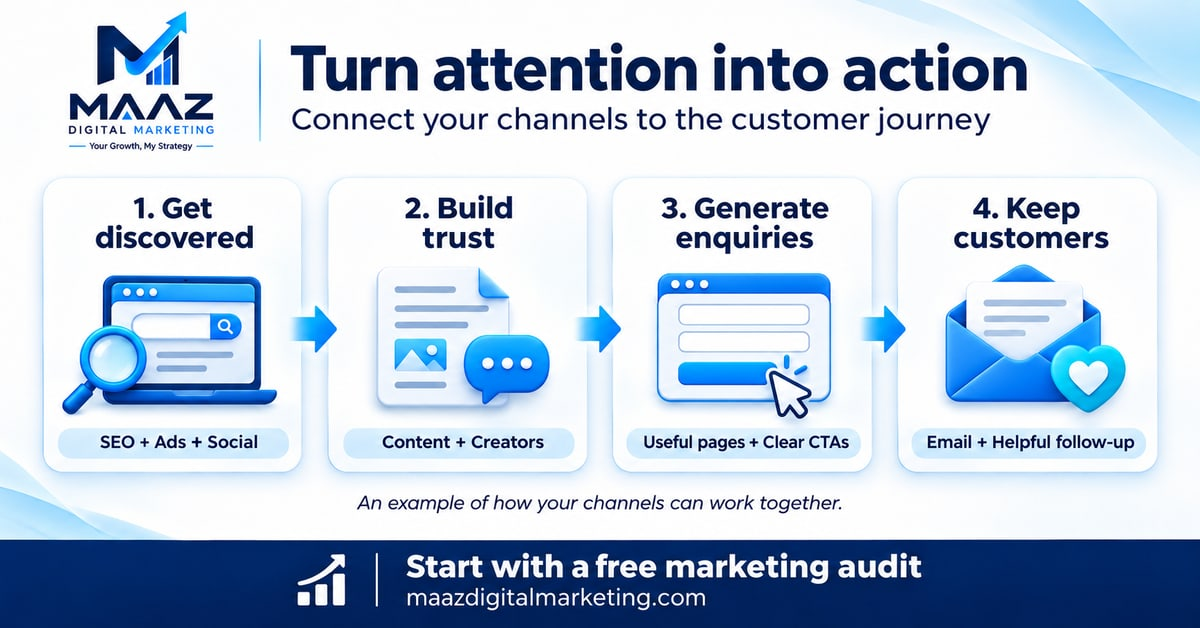
Illustrative clothing-store journey:
- A shopper discovers a product through a creator's demonstration.
- The shopper searches for the brand and reads its product and delivery information.
- A clear product page helps the shopper place an order.
- After choosing to subscribe, the customer receives relevant collection updates.
The creator might earn a fixed fee, an affiliate commission, or both. Search, content, and email support the journey, while advertising can extend relevant reach. Record each order once when calculating total revenue.
How do you measure whether digital marketing is working?
Measure digital marketing against business outcomes such as qualified inquiries, completed purchases, and profitable repeat orders. Use traffic and engagement to diagnose performance, then connect them to sales records where possible. Keep definitions, reporting periods, and attribution methods consistent so that apparent growth does not hide poor lead quality or rising costs.
|
Metric |
Formula |
What it helps you assess |
|---|---|---|
|
Website enquiry conversion rate |
Enquiries ÷ website sessions × 100 |
How often do visits produce inquiries? |
|
Cost per qualified lead |
Campaign spend ÷ qualified leads |
The cost of attracting suitable prospects |
|
Return on ad spend (ROAS) |
Attributed revenue ÷ ad spend |
Revenue attributed to advertising, not profit |
Worked example, not a client result: A campaign spends PKR 30,000 and generates 30 inquiries, of which 10 meet the business's qualification criteria. Cost per inquiry is PKR 1,000, while cost per qualified lead is PKR 3,000.
If attributed revenue is PKR 90,000, ROAS is 3×. Profit still depends on product costs, fulfillment, commissions, fees, returns, and other expenses. State whether your cost calculation includes only media spend or the full campaign cost.
Ad platforms may attribute the same purchase to multiple channels. Reconcile reports against actual orders and your customer records before adding revenue totals together. For a local service business, a WhatsApp click is also not automatically a qualified enquiry or a booking.
Start with a clear next step
Choose one business outcome and identify what currently prevents it: visibility, buyer confidence, conversion, or follow-up. That gives you a more useful starting point than buying a little of every service.
Maaz Digital Marketing helps businesses in Hyderabad and across Pakistan with SEO, Google Ads, Meta advertising, content, and conversion optimization. If you need help setting priorities, request your free SEO and marketing audit on WhatsApp.
Send your website or business page, the area you serve, and the result you want to improve. You can also email Maaz Digital Marketing to get the conversation started.
Frequently asked questions
What is the difference between SEO and PPC?
SEO improves a website's ability to attract visitors through unpaid search results, while PPC is an advertising model that charges for ad clicks. SEO requires ongoing work and can take time to show impact; PPC can bring visits once ads serve, but neither guarantees leads or sales.
How is digital marketing different from social media marketing?
Digital marketing is the wider practice of using online channels and digital communication to reach and retain customers, including search, advertising, content, email, and partnerships. Social media marketing is one part of that practice, focused on platforms such as Instagram, Facebook, LinkedIn, and TikTok.
What is the difference between influencer and affiliate marketing?
Influencer marketing focuses on a creator's relationship with a relevant audience, while affiliate marketing focuses on paying a partner for tracked, agreed outcomes such as sales. A creator can participate in both by publishing sponsored content and earning commissions on eligible purchases through a referral link.
Can a small business start digital marketing with a limited budget?
A small business can begin with a focused offer, useful website or profile information, and one channel that matches how its customers buy. Limited budgets make prioritization and measurement especially important: account for your time, improve the inquiry process, and expand spending only when the economics support it.
How long does digital marketing take to produce results?
Digital marketing timelines depend on the channel, competition, starting position, and sales cycle; paid ads can generate visits after they begin serving, while SEO changes may take weeks or months to assess. Early clicks are not proof of profitable growth, so evaluate qualified inquiries and completed sales over time.